
In the previous parts of this series, we explored probability as a tool that emerges when complete information is unavailable. We examined how probability can describe our knowledge rather than necessarily describing reality itself. In this part, we move from philosophy to everyday practice and explore how probability helps us make decisions, measurements, and predictions in a world that is often too complex to observe in full detail.
1]Temperature: A Single Number Hiding Countless Details
Consider a liter of water at 80°C.
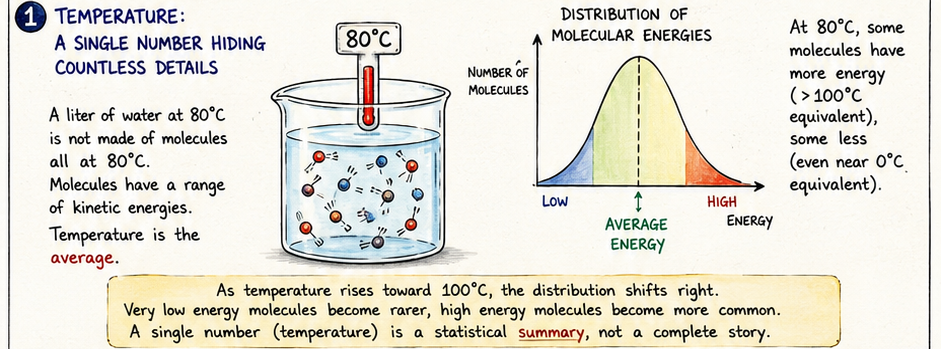
When we measure the temperature, we obtain a single number. Yet that number hides an enormous amount of information. The water contains an unimaginable number of molecules moving in different ways. Some molecules possess more kinetic energy than average, while others possess less.
The temperature does not describe every molecule individually. Instead, it represents the average behavior of an immense collection of molecules.
As heat is added and the temperature approaches 100°C, the distribution of molecular energies changes. High-energy molecules become more common, while very low-energy molecules become less common. The temperature reading provides a useful summary, but it does not reveal every microscopic detail.
This illustrates an important principle: many measurements in science are not complete descriptions of reality. They are practical summaries of systems that are too complex to describe in full.
2] Designing for Probability
Probability is not limited to scientific measurements. It also guides practical decisions in engineering and planning.
Imagine an office building with 400 employees and 10 washrooms.
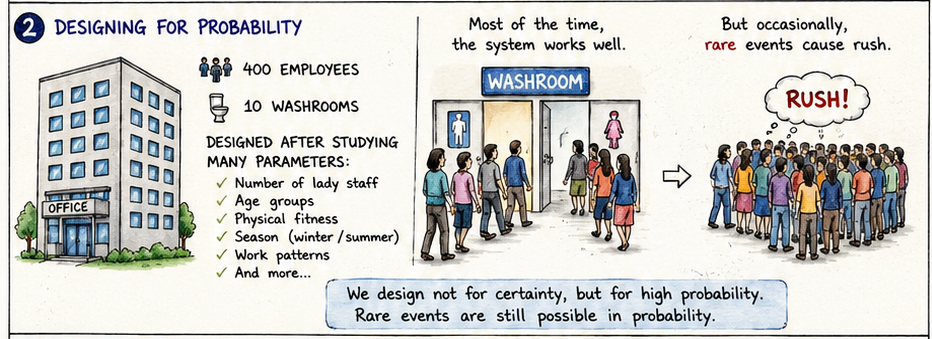
The designers cannot predict exactly who will use a washroom at a particular moment, how long each person will stay, or whether many people will need the facilities simultaneously. Instead, they study statistical patterns. Factors such as workforce size, gender distribution, age groups, seasonal effects, and typical usage patterns are considered.
Most of the time, the design works well because human behavior tends to follow predictable statistical patterns.
However, occasional queues still occur.
This does not mean the design failed. It simply reflects the fact that probability never guarantees a specific outcome. Rare events remain possible even when they are unlikely.
Much of modern infrastructure operates in this way. Roads, airports, hospitals, communication networks, and power systems are often designed not for certainty, but for highly probable conditions.
3] Searching for Life Beyond Earth
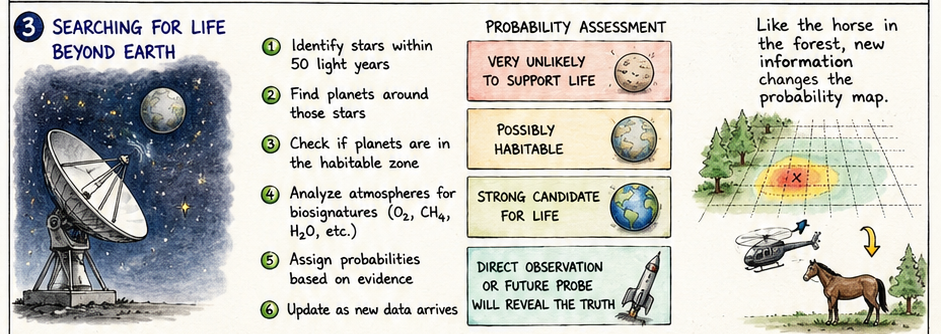
Probability also becomes essential when direct observation is impossible.
Suppose scientists wish to estimate the likelihood of life on planets within 50 light-years of Earth.
At present, we cannot travel to these planets and inspect them directly. Instead, scientists gather indirect evidence.
They may identify planets orbiting nearby stars, determine whether those planets lie within a habitable zone, and analyze atmospheric signatures that could indicate biological activity.
Based on available evidence, probabilities are assigned.
Some planets may appear unlikely to support life. Others may seem promising. As new observations become available, the estimates change.
This process resembles the horse-in-the-forest example discussed earlier in this series. When the horse’s location is unknown, we create a probability map. As new information arrives, the map changes. If a helicopter eventually spots the horse, the uncertainty disappears.
Similarly, probabilities regarding extraterrestrial life may evolve as evidence accumulates. Direct observation, if it ever becomes possible, would replace estimation with knowledge.
4] Not All Probabilities Are Equal
The word “probability” is often used as though it represents a single idea. In reality, different situations involve different kinds of probability.
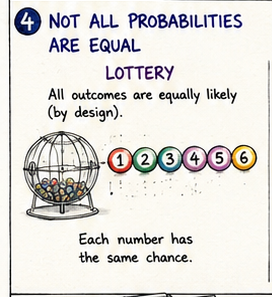
Consider a lottery.
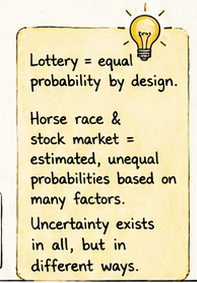
In a properly designed lottery, every valid number combination is intended to have the same chance of winning. No ticket possesses an inherent advantage. The probabilities are equal by design.
Now consider a horse race.
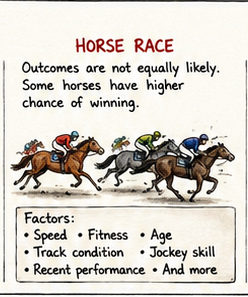
Not all horses have the same probability of winning. Factors such as fitness, speed, experience, track conditions, and jockey performance influence the outcome. Some horses may have a significantly greater chance of success than others.
The stock market presents an even more complicated example.
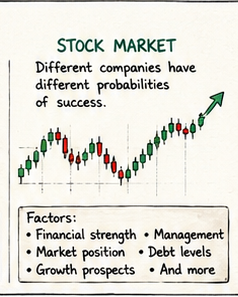
Companies differ in management quality, financial strength, innovation, market position, and countless other factors. Investors therefore do not treat every stock as equally likely to succeed.
In a lottery, uncertainty exists despite equal probabilities.
In horse racing and stock markets, uncertainty exists alongside unequal probabilities.
This distinction is important. Sometimes probability arises because outcomes are deliberately made equally likely. At other times, probability reflects our attempt to estimate the effects of many underlying factors.
Probability as a Practical Tool
These examples reveal a common theme.
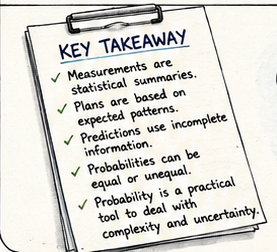
Temperature summarizes countless molecular motions.
Building design relies on expected patterns of human behavior.
The search for extraterrestrial life depends on incomplete information and evolving evidence.
Horse races and financial markets involve estimating unequal chances based on known factors.
In each case, probability serves as a practical tool for dealing with complexity and uncertainty.
Rather than tracking every molecule, every employee, every planet, or every market participant, we use probability to create workable descriptions of situations that would otherwise be impossible to analyze.
Probability does not always tell us exactly what will happen.
Instead, it helps us navigate a world where complete information is often unavailable, incomplete, or too vast to process.
Perhaps this is one of the most important lessons of probability. It is not merely a branch of mathematics.
It is a bridge between limited knowledge and practical understanding. It allows us to make sense of systems that are too large, too distant, or too complex to observe in their entirety.
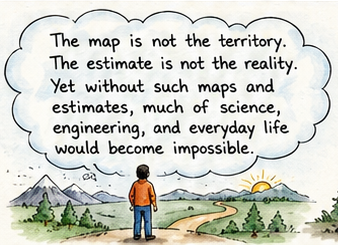
The map is not the territory. The estimate is not the reality. Yet without such maps and estimates, much of science, engineering, and everyday life would become impossible.
Part 1 – Understanding Probability We began by examining what probability really means and why it becomes necessary whenever complete information is unavailable.
Part 2 – Patterns, Statistics, and Hidden Causes We explored how large collections of events can display predictable statistical behavior even when individual outcomes remain uncertain.
Part 3 – The Horse in the Forest Using the lost horse analogy, we examined probability as a description of knowledge and how new information can reshape our estimates.
Part 4 – Multiple Truths and Multiple Descriptions We considered how different observers can construct different yet useful descriptions of the same reality, depending on the information available to them.
Part 5 – Estimation and Probability in Everyday Life We saw how probability influences scientific measurement, engineering design, prediction, and decision-making, serving as a practical tool for navigating an uncertain world.
Coming Next: The Types of Information Series
Scientific reasoning depends not only on logic, but also on the information available to us. Throughout history, discoveries have emerged from hidden information, theories have changed because of new information, and mysteries have persisted because information was lost, distant, microscopic, or simply unavailable. In this upcoming series, we will explore how different types of information—and limitations on information—shape scientific understanding. From lost knowledge and distant galaxies to hidden structures and mistaken assumptions, we will examine how the nature of information itself influences the way science progresses.
If you do not want to miss any good article, Subscribe
Subscribe to our newsletter!

