Introduction :
One of the hidden assumptions behind probability is that there is a single truth waiting to be discovered. We may not know it yet, and probability helps us estimate it, but we often assume that reality itself points toward one correct answer.
But what if reality is more subtle?
In many situations, the same event, object, or system can produce multiple valid truths depending on perspective, scale, representation, information, or the state of the observer. These truths do not necessarily contradict each other. Instead, they emerge from different ways of interacting with the same underlying reality.
The examples in this chapter are not intended to prove any scientific theory. They are thought experiments designed to explore a simple question: If multiple valid truths can coexist in everyday life, mathematics, perception, and experience, what role might this play in our understanding of probability, prediction, and observation?
Perhaps probability is not always a measure of randomness alone. In some cases, it may also reflect the existence of multiple possible truths available to different observers.
Interesting examples ( I will present examples designed by me) :
1] Coin: head and tail (multiple observation truths)
A person tosses a coin and reports the result as heads. Another person also observes the same coin and reports it as tails. How can both be correct?
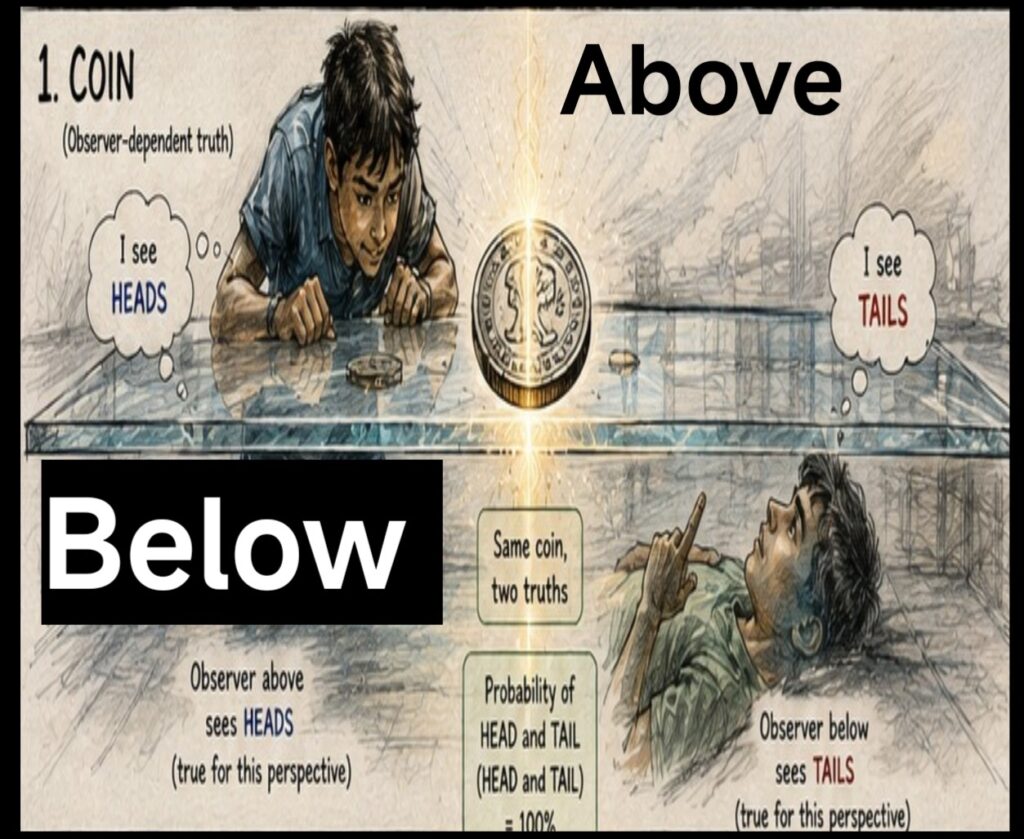
In my imagination, the person who sees heads is standing above a transparent glass floor, viewing the coin from the top. The other person is below the glass floor, looking upward. Since the floor is transparent, they see the opposite face of the same coin. One sees heads, the other sees tails. Both conclusions are true from their respective perspectives.
Connection to “Multiple Truths” in Beyond Probability
This example highlights that probability is not only about the object (the coin), but also about the observer’s information boundary.
The coin has a single physical state at any moment.
But observations differ depending on perspective and access to information.
Each observer constructs a “truth” that is locally consistent.
So the “multiple truths” here are not contradictions in reality, but parallel valid descriptions of the same system under different observational frames.
Impact on Probability and Prediction
In standard probability, the coin is treated as a single system with one outcome. But your framing introduces a shift:
Probability becomes observer-conditioned rather than absolute.
Prediction depends on what part of the system is visible to the observer.
Two different “truth states” can exist simultaneously as information states, not physical conflicts.
So in Beyond Probability terms:
what changes is not the coin — but the information map around the coin.
2) Equation: (multiple solution truths)
Consider the equation x. A person stands at zero on a number line and asks
“In which direction should I move to reach the answer ?”
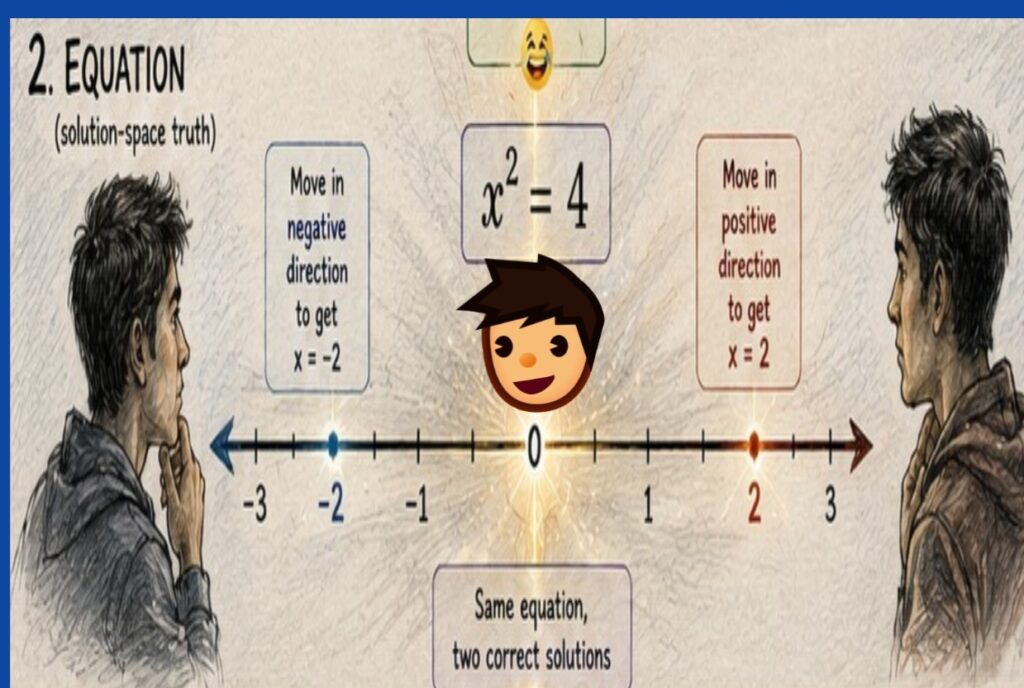
One person says: move in the positive direction to reach
Another person says: move in the negative direction to reach .
Both are correct, because the equation does not have a single outcome. It has two valid solutions emerging from the same rule.
So depending on direction, the same mathematical system produces different but valid results.
This example shows that even in deterministic mathematics, “truth” can branch into multiple valid outcomes.
The equation is one system.
But it does not collapse into one answer; it expands into a set of valid truths.
Each solution is correct within the same governing rule.
So the “truth” is not a single point — it is a solution space.
Impact on Probability and Prediction
In a standard view, we often expect one prediction per system. But here:
Prediction becomes a set of allowed outcomes, not a single result.
The system is deterministic, but the outcome is multi-valued.
Probability interpretation shifts from “what will happen” to “what is permitted by the structure.”
So in Beyond Probability terms, this shows that even certainty-based systems can contain built-in multiplicity of truth, where one equation naturally unfolds into more than one correct reality.
Note :This idea of multiple correct possibilities connects closely to the particle–wave nature of a photon. In classical thinking, we expect a photon to have a single definite identity: either a particle or a wave. But in reality, it behaves as both depending on how it is observed. In some experiments, it appears as a localized particle hitting a detector at a specific point. In others, it behaves like a wave spreading through space and creating interference patterns. Both descriptions are correct, yet neither is complete on its own. The photon does not change its nature; instead, the type of measurement selects which “truth” becomes visible, similar to how different observers in earlier examples arrive at different valid outcomes from the same underlying system.
3) Roman numeral equation (multiple interpretation truth)
An equation like X + I = XI appears on a banner in a large hall. On the opposite side, it is perceived as IX = I + X due to reversed viewing orientation.
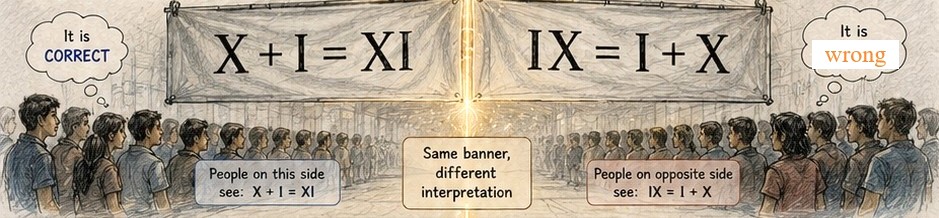
Spectators on the left side say the equation is correct, while spectators on the right side say the equation is wrong. Both groups firmly believe their interpretation is true.
Here, truth depends not on the system itself, but on how the system is represented and perceived.
4) Relativity of size (multiple truth through scale of observer)
This is my own childhood experiance.
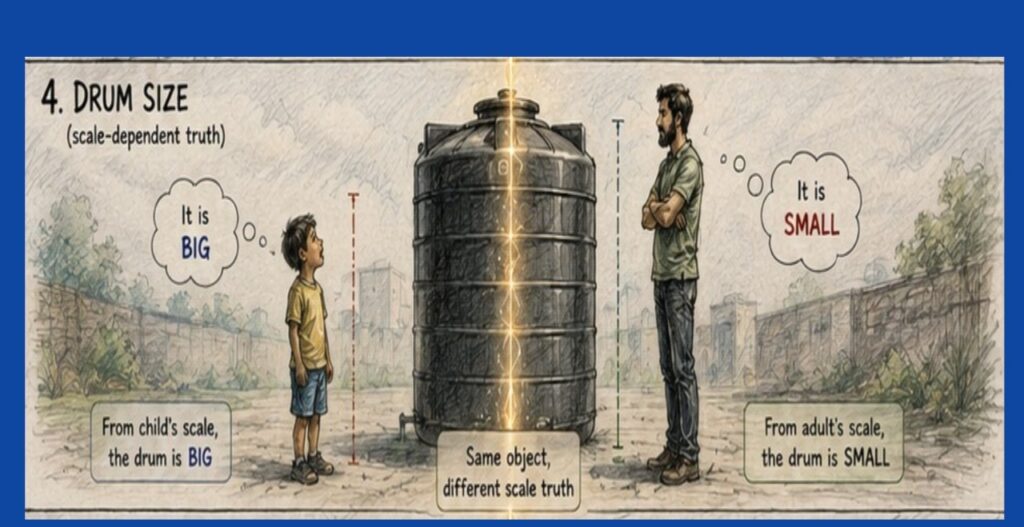
When I was a child, my father bought a large water drum. Since it was taller than my height (about 3 feet), I told my brother that my father had bought a big drum.
Later, my father, who is 5 feet 3 inches tall, told his friend that he had bought a small drum for storing water.
The drum is the same object, but its size is described differently depending on the observer’s physical scale. Both descriptions are true within their own reference frames.
5) Relativity of feeling (same event, different experiential truth)
A young child and an elderly grandfather are travelling in a public vehicle. The vehicle moves fast and crosses a bump, causing a sudden jerk.
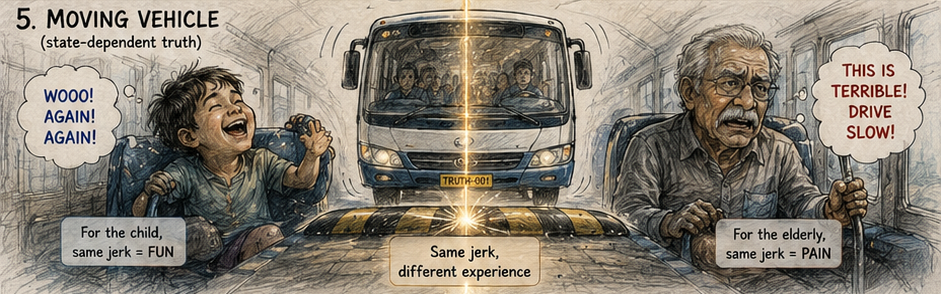
The child enjoys it, laughing and asking for more. The experience feels exciting and playful. The elderly person, however, feels discomfort and scolds the driver for the rough movement.
The physical event is the same, but the experienced truth is completely different, depending on age, body condition, and mental state.
Beyond a Single Truth concept
The examples in this chapter share a common pattern. The underlying reality remains the same, yet different observers arrive at different truths. The coin does not change. The equation does not change. The banner, the drum, and the moving vehicle do not change. What changes is the observer’s position, information, scale, interpretation, or state of experience.
This does not mean that all claims are equally true, nor does it imply that reality is arbitrary. Rather, it suggests that truth can sometimes be layered, with different aspects becoming visible under different conditions.
If this idea has any relevance to probability, then probability may be more than a tool for measuring uncertainty. It may also be a reflection of the gap between an underlying reality and the many valid ways that reality can be observed, represented, and understood.
Perhaps the deepest lesson is not that reality contains many truths, but that a single reality can give rise to many truths without ceasing to be one reality.
And
if that is possible, then probability may be telling us as much about observers as it does about the world they are trying to observe.
A Preview of Part 5
In the previous parts of this series, we explored probability as a way of dealing with incomplete information and uncertainty. But probability is not confined to abstract mathematics or philosophical discussions. It quietly influences many aspects of everyday life, scientific measurement, engineering design, and even our search for life beyond Earth. In Part 5, we will examine how probability is used as a practical tool for estimation and prediction, helping us make sense of complex systems when complete knowledge is impossible.
